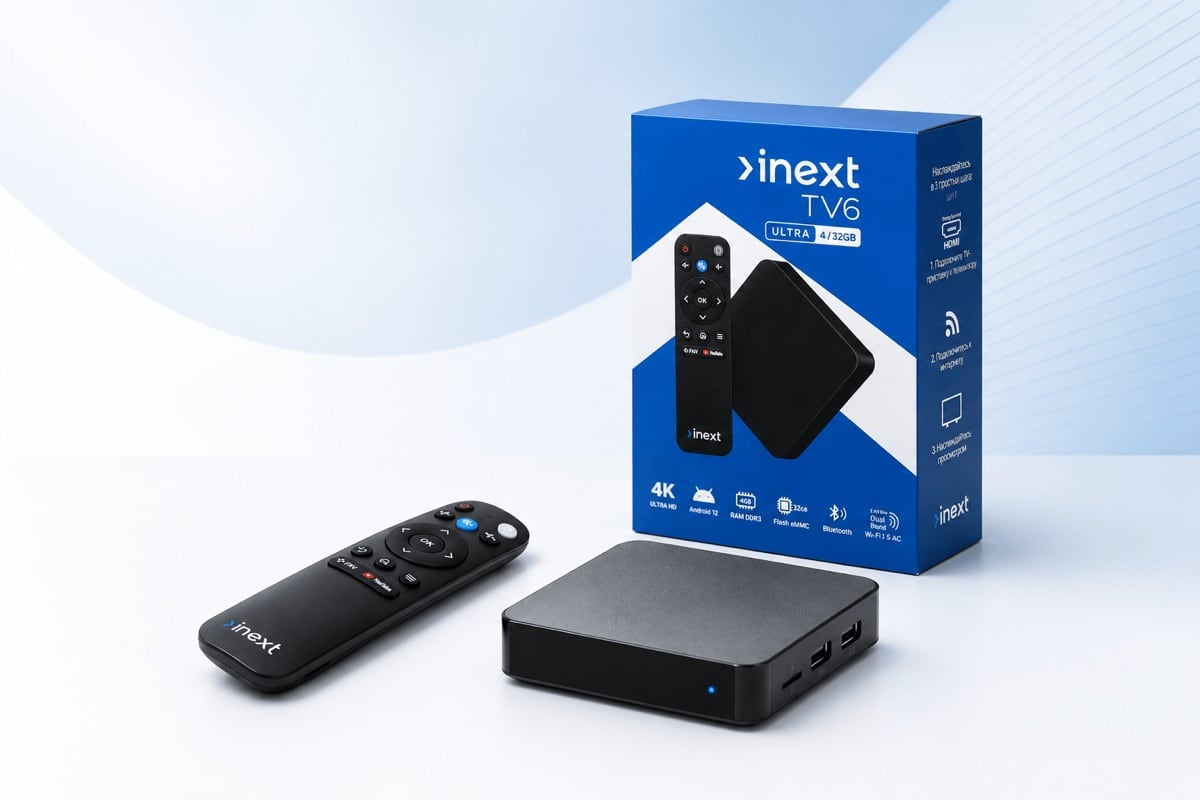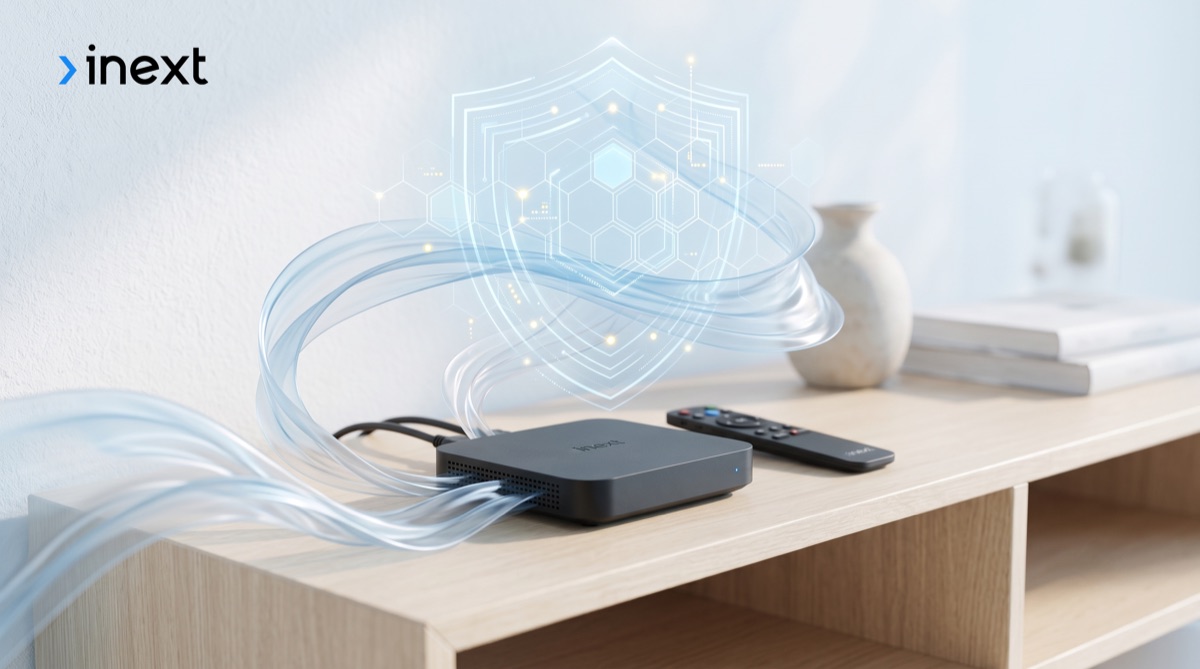
The inext TV5, TV5 Ultra, TV6, and TV6 Ultra are Android set-top boxes designed for operator TV and streaming deployments. Their latest firmware adds a new layer of thermal protection: a system notification that recognizes sustained heat and gives the subscriber a clear action before the condition becomes more serious.
The feature is designed to be useful without becoming noisy. A brief temperature spike does not immediately trigger an alert. The warning appears only when thermal pressure continues long enough to indicate that the device needs attention.
Availability: thermal notifications are included in firmware 1.18.x for the TV5 series and 1.9.x for the TV6 series. The applicable build and rollout schedule can vary by operator deployment.
Why thermal awareness matters
Modern set-top boxes perform continuous video decoding, networking, application, and interface work in a compact enclosure. Their thermal state can change with the workload, ambient conditions, and where the device is installed.
Android already uses thermal information to protect the system. As thermal stress rises, the platform can reduce available processing capacity; at more severe levels, performance and device functionality can be affected. The new inext notification complements those platform safeguards by making the condition visible and giving the subscriber practical guidance.
A warning designed around sustained conditions
The notification follows a staged approach:
- Monitor the condition over time. The system distinguishes sustained thermal pressure from short-lived peaks.
- Show an early warning. The first message asks the subscriber to move the set-top box to an open, well-ventilated area.
- Escalate when necessary. If the thermal condition becomes more serious and persists, the system displays a stronger warning.
- Wait for a stable recovery. The warning state clears only after the device has remained cooler for a defined period, preventing messages from repeatedly appearing and disappearing near a boundary.
This recovery margin is commonly known as hysteresis. Android's own thermal guidance describes it as a way to keep thermal-state decisions stable instead of reacting to every small fluctuation.
Clear guidance for subscribers
Thermal throttling normally happens in the background, so a subscriber may notice slower behavior without knowing why. The new notification explains what is happening and gives one direct response: place the set-top box in a cooler, open, well-ventilated location and allow it to recover.
The alert does not replace Android's built-in thermal safeguards. It adds a useful communication layer before the system reaches a more severe state.
More context for operator support
For operators, a visible thermal warning can make a support conversation more precise. Instead of treating slower performance as an unexplained software or network problem, support teams and subscribers have an immediate indication that the installation environment should be checked.
The same behavior across the TV5 and TV6 families also gives operators a consistent subscriber experience across several inext deployment options. It continues the long-term software support reflected in the TV5 and TV5 Ultra software update while extending a new reliability feature to the newer TV6 and TV6 Ultra generation.
Further reading
- Android Open Source Project: Thermal mitigation — how Android monitors thermal severity and applies protective actions.
- Android Developers: Thermal API — an overview of thermal status, headroom, throttling, and recovery.